The Arachnida Attack
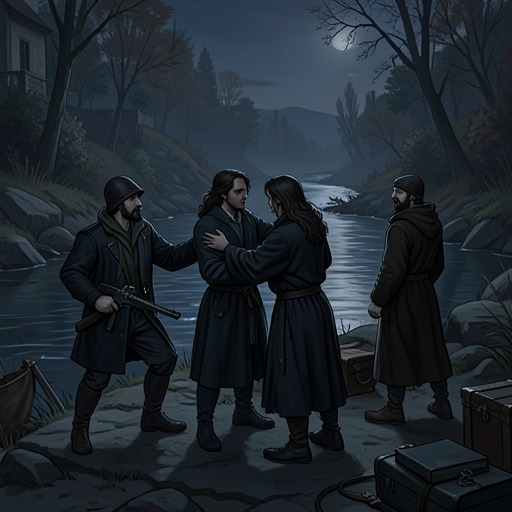
The Ballad of the Last DragonThe Arachnida Attack is a sudden riverbank assault that interrupts Sylvaine Abelan and Jaromir at their most unguarded and forces their expedition into a brutal struggle against creatures resembling giant spiders but protected by bluish-black armor. Its decisive significance lies not only in the physical danger: the encounter makes Sylvaine act despite fear, leaves Jaromir seriously wounded, and brings Neith and Cadoc’s protective partnership into the open.
Causes and Background
The attack begins with a warning that is heard before it is understood. A low hum moves through the trees, punctuated by a repeated click-click, and Jaromir immediately recognizes the danger well enough to tense and order Sylvaine away. The sound’s growing volume converts the surrounding woodland from a private refuge into hostile territory. His urgency is not theatrical; when the creatures emerge, they appear in a clearing only a short distance away, already numerous enough to make hesitation perilous.
The attackers are a swarm of dozens of monsters roughly the size of ponies. Their movement recalls giant spiders, but their bodies are enclosed in a shining bluish-black shell compared to black moonstone, while long, spiked tails flick with lethal purpose. Their pincers snap rhythmically, giving the assault a mechanical, almost ritualized sound. This combination of scale, armor, and poisonous menace distinguishes them from ordinary animals and explains Jaromir’s immediate decision that escape, rather than confrontation, is the only sensible first response.
The attack also belongs to a wider world in which danger is unevenly distributed across history and society. Sylvaine’s reflections on the Hawthokian alliance with humans during The Unification and The Great Loss explain why a dwarven-descended barkeep can move easily through a human setting while an elven person would likely encounter suspicion and hostility. The same history includes the destruction of elven texts and sacred structures, the survival of elven knowledge through spoken transmission, and a long campaign of fear that later becomes direct violence. The Arachnida Attack therefore occurs against a background where survival is already shaped by inherited conflict, displacement, and the loss of secure refuge.
The First Break in the Escape
Sylvaine’s first instinct is to obey Jaromir’s command and climb. She reaches for the tallest branch, hauling herself upward with one hand while carrying stones for improvised ammunition. From the tree she hears the fight before she fully sees it: sword striking shell, pincers snapping toward exposed flesh, and the creatures’ shrill cries as Jaromir cuts into them. The height gives her a temporary advantage, but it does not separate her from the danger. She waits on a thick branch halfway up, close enough to aim, then throws a rock at the beast creeping toward Jaromir’s flank. The blow lands with enough force to produce an ear-splitting scream, turning Sylvaine’s fear into a direct intervention.
Jaromir’s Wounding and Sylvaine’s Return
The intervention buys Jaromir only a moment. He cries out, and Sylvaine descends so quickly that the tree scrapes her knees and palms. By the time she reaches the river, four creatures remain, while Jaromir stands chest-deep in the water with a wide gash across his thigh. Blood blooms and disperses in the current, his posture has collapsed into an uneven favoring of the injured leg, and his widened eyes warn her away even as his condition makes retreat impossible. Sylvaine answers by drawing the creatures’ attention toward herself, shouting for Jaromir to use the opening. He responds with ruthless precision, bringing his sword down to cleave the tails from two beasts before him. Her next rock misses, however, and the remaining creatures continue advancing as Jaromir trembles and appears close to collapsing. With no weapon of her own, Sylvaine places her body in front of him, transforming the impulse to flee into a conscious act of protection.
Rescue, Injury, and Aftermath
The crisis turns when a whistle cuts through the air, followed by the hard impact of an arrow striking the creature nearest Sylvaine and Jaromir. Neith and Cadoc race into view, and Cadoc fires again with the bow Jaromir had devoted so much care to maintaining. His arrow finds the gap between the armored plates along another beast’s back. Neith reaches the river moments later, spins her sword, and drives it through the skull of the last remaining creature, pinning the body to the riverbed. The rescue is therefore collective: Sylvaine’s distraction and attempted defense create time, while Cadoc’s archery and Neith’s decisive attack end the immediate threat. Jaromir, however, remains on the bank, and when Sylvaine takes his face in her hands, his eyes roll back, making the victory inseparable from fear of what the wound has done to him.
Cadoc and Neith identify the injury as more than a simple cut. When Neith tears Jaromir’s trouser leg open, the skin around the gash has already turned yellowish purple, an impossible-looking discoloration that signals the creature’s venom. Cadoc pours an amber remedy over the wound; it steams and hisses against Jaromir’s flesh, provoking a muffled growl behind his clenched jaw. He then gives Jaromir a vial of the same concoction to drink while Sylvaine steadies and comforts him. Neith insists that the group return to camp before the fever dreams begin, recalling her own earlier venom-induced fever and clarifying the stakes of the treatment. Cadoc had brewed the sepsis oil before it was needed, so his preparation becomes the practical difference between an untreated envenomation and a survivable one.
Wider Consequences and Thematic Significance
The attack’s immediate violence is set within a larger ecology of inherited danger. The creatures’ nest, encountered later as beasts with mottled gray flesh prowling among carrion, shows that the expedition is moving through landscapes where predation has become organized and visible rather than exceptional. That environmental threat stands beside older human-made harms: black powder stored in four barrels within the dragon’s mechanisms room preserves the weaponry once used to defeat the elves, even after saltpeter was outlawed as inhumane. The Arachnida Attack consequently belongs to a narrative pattern in which danger is never only personal. Sylvaine’s people have been dispossessed through laws that stripped elves of titles and land, branded those who resisted as fugitives, and licensed humans to hunt them for sport; survival at the river therefore carries the pressure of a history in which bodies, homes, and even cultural memory have repeatedly been made vulnerable by force.
Ethical Reversal and the Refusal of Retaliation
The Arachnida Attack gains further significance from the moral choice it helps prepare in Sylvaine Abelan. Faced elsewhere with the power to kill a helpless human attacker, she recognizes how easily fear can be reversed into domination: the sword is poised at his pulse, and death would make him experience the terror he had inflicted. Yet she lowers the blade because she does not want his blood to become a permanent companion. Her declaration that she is not human and does not want to be is not a rejection of violence in every circumstance—the river encounter shows her throwing stones and placing her body between Jaromir and the creatures—but a refusal to let vengeance define her identity. The attack thus establishes a contrast between necessary defense against immediate predators and retaliatory killing after the danger has passed. Sylvaine’s survival is measured not only by whether she remains alive, but by whether she can retain agency without reproducing the logic that has made elves into hunted bodies.
Rescue, Injury, and Aftermath
The crisis turns when a whistle cuts through the air, followed by the hard impact of an arrow striking the creature nearest Sylvaine and Jaromir. Neith and Cadoc race into view, and Cadoc fires again with the bow Jaromir had devoted so much care to maintaining. His arrow finds the gap between the armored plates along another beast’s back. Neith reaches the river moments later, spins her sword, and drives it through the skull of the last remaining creature, pinning the body to the riverbed. The rescue is therefore collective: Sylvaine’s distraction and attempted defense create time, while Cadoc’s archery and Neith’s decisive attack end the immediate threat. Jaromir, however, remains on the bank, and when Sylvaine takes his face in her hands, his eyes roll back, making the victory inseparable from fear of what the wound has done to him.
Rescue, Injury, and Aftermath
The crisis turns when a whistle cuts through the air, followed by the hard impact of an arrow striking the creature nearest Sylvaine Abelan and Jaromir. Neith and Cadoc race into view, and Cadoc fires again with the bow Jaromir had devoted so much care to maintaining. His arrow finds the gap between the armored plates along another beast’s back. Neith reaches the river moments later, spins her sword, and drives it through the skull of the last remaining creature, pinning the body to the riverbed. The rescue is therefore collective: Sylvaine’s distraction and attempted defense create time, while Cadoc’s archery and Neith’s decisive attack end the immediate threat. Jaromir, however, remains on the bank, and when Sylvaine takes his face in her hands, his eyes roll back, making the victory inseparable from fear of what the wound has done to him.
Ethical Reversal and the Refusal of Retaliation
The Arachnida Attack gains further significance from the moral choice it helps prepare in Sylvaine Abelan. Faced elsewhere with the power to kill a helpless human attacker, she recognizes how easily fear can be reversed into domination: the sword is poised at his pulse, and death would make him experience the terror he had inflicted. Yet she lowers the blade because she does not want his blood to become a permanent companion. Her declaration that she is not human and does not want to be is not a rejection of violence in every circumstance—the river encounter shows her throwing stones and placing her body between Jaromir and the creatures—but a refusal to let vengeance define her identity. The attack thus establishes a contrast between necessary defense against immediate predators and retaliatory killing after the danger has passed. Sylvaine’s survival is measured not only by whether she remains alive, but by whether she can retain agency without reproducing the logic that has made elves into hunted bodies.